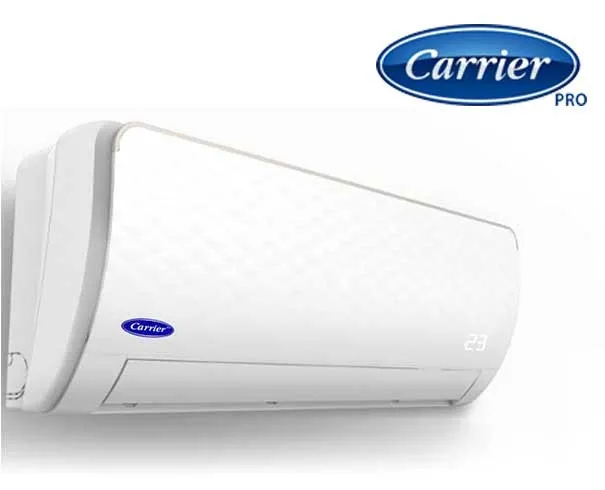
Carrier Air Conditioners in Singapore: Complete Guide
Carrier is one of the most recognisable names in air conditioning and HVAC. The brand is strongly associated with cooling engineering and commercial climate-control systems, making it particularly interesting for users who prioritise dependable cooling, system performance, and larger-scale air-conditioning requirements.
Carrier's product range extends beyond ordinary residential wall-mounted air conditioners. Its portfolio includes split systems, cassette systems, ducted systems, floor-standing systems, VRF solutions, and other commercial HVAC technologies.
That broader engineering background is one reason Carrier can be considered when selecting an air-conditioning system for a home, office, retail space, restaurant, or larger commercial property.
Why Choose Carrier Air Conditioners?
Carrier's main strength is its HVAC-focused engineering approach.
Rather than positioning air conditioning purely as a smart-home appliance, Carrier has historically focused heavily on cooling performance, system efficiency, air distribution, and commercial applications.
Depending on the product range, Carrier offers technologies designed for:
- Energy-conscious operation.
- High cooling capacity.
- Inverter-based performance.
- Flexible installation.
- Large commercial spaces.
- Multi-zone cooling.
- Ducted air distribution.
- Cassette air distribution.
- VRF applications.
- Professional maintenance and system servicing.
For users who want an air conditioner that can handle demanding usage, Carrier is worth considering.
Types of Carrier Air Conditioning Systems
Carrier has a particularly broad range of system configurations.
### 1. Wall-Mounted Split Systems
These are suitable for bedrooms, small offices, living rooms, and other individual spaces.
They are relatively straightforward and are often the most practical solution when one room needs dedicated cooling.
### 2. Cassette Air Conditioners
Cassette systems are designed for spaces where airflow needs to be distributed across a wider area.
Carrier's current XPOWER range includes 1-way and 4-way cassette inverter systems. These are aimed at applications such as offices, hotels, reception areas, restaurants, showrooms, and other spaces.
### 3. Ducted Air Conditioners
A ducted system places much of the air-conditioning equipment out of direct sight while distributing conditioned air through ducts and ceiling outlets.
Carrier's XPOWER ducted systems are designed for layouts where concealed installation is desirable.
### 4. Floor-Standing Systems
Floor-standing units are useful where wall or ceiling installation is inconvenient or where a larger volume of air needs to be delivered.
Carrier's XPOWER range includes inverter floor-standing fan-coil systems with relatively high cooling capacities.
### 5. Under-Ceiling Systems
These systems can be installed beneath ceilings and are useful for spaces that require broad air distribution without a conventional wall-mounted indoor unit.
Carrier's XPOWER under-ceiling systems use automatic airflow adjustment and swing functions on selected models.
### 6. VRF Systems
VRF, or Variable Refrigerant Flow, is designed for larger and more complex buildings.
Instead of treating each room as a completely independent system, VRF can connect multiple indoor units to a larger outdoor system.
This makes VRF suitable for:
- Office buildings.
- Hotels.
- Commercial properties.
- Large residences.
- Retail spaces.
- Multi-zone installations.
Carrier's XPower VRF systems support multiple indoor units and are designed for flexible large-scale installation.
Energy Efficiency: Carrier Air Conditioners
Carrier's approach to efficiency is strongly connected to inverter technology and part-load performance.
A compressor does not always need to run at maximum capacity. Once a room approaches the desired temperature, the cooling requirement may decrease.
Inverter technology allows the compressor to adjust its operating speed according to demand.
Carrier's XPOWER systems are designed around this principle. Carrier states that XPOWER uses inverter technology and is designed to achieve high part-load efficiency and seasonal efficiency.
Carrier also uses technologies such as Full DC Inverter Technology in some VRF systems, allowing more precise compressor speed control.
For Singapore homes, this matters because air conditioners may be running for many hours each day.
Still, efficiency is not just about the compressor.
Real-world electricity consumption also depends on:
- Correct capacity selection.
- Room insulation.
- Outdoor temperature.
- Temperature setting.
- Filter cleanliness.
- Refrigerant condition.
- Installation quality.
- Duct condition where applicable.
- Daily usage pattern.
What Technology Makes Carrier Air Conditioners Different?
Carrier's technology portfolio is especially interesting when the requirement moves from simple residential cooling toward system-level HVAC performance.
### XPOWER Inverter Technology
XPOWER systems use inverter technology to adjust capacity based on demand.
This can provide better part-load performance than systems that operate only at fixed speeds.
### Full DC Inverter Technology
Selected Carrier VRF systems use Full DC Inverter Technology to improve operating efficiency and provide more precise capacity control.
### EVI Compressor Technology
Carrier's XPower VRF range includes Enhanced Vapor Injection compressor technology, designed to improve system capacity and performance across a broad operating range.
### Micro-Channel Heat Exchanger
Some Carrier VRF systems use micro-channel heat exchangers to improve heat-transfer performance through a compact heat-exchanger design.
### IP55 Sealed Electrical Box
Selected XPower VRF systems feature sealed electrical boxes designed to protect critical components from environmental contamination such as dust and moisture.
### System Redundancy
For larger installations, reliability can be more important than simply having a powerful compressor.
Carrier's XPower VRF technology includes sensor backup and multiple backup mechanisms intended to help maintain system operation in case of component issues.
Core Innovations and Technologies Highlights
| Carrier Technology | Purpose | Why It Matters |
|---|---|---|
| XPOWER Inverter | Adjusts cooling output according to demand | Better part-load operation |
| Full DC Inverter | Precise compressor control | Helps improve efficiency |
| EVI Compressor | Enhanced refrigerant compression technology | Supports higher capacity and wider operation |
| Micro-Channel Heat Exchanger | Efficient heat transfer | Supports compact and efficient system design |
| VRF Technology | Multiple indoor units on larger systems | Suitable for multi-zone buildings |
| Sensor Backup | Provides backup monitoring | Helps support system reliability |
Carrier describes its XPower VRF system as supporting wide operating ranges, long piping configurations, smart maintenance functions, and multiple system redundancy features.
Maintenance and Longevity
Air conditioning is a mechanical system. Even a well-engineered Carrier unit requires regular attention.
Carrier recommends preventive maintenance because dirt and debris can reduce system performance and contribute to premature problems. Typical professional maintenance can include filter inspection, coil cleaning, refrigerant checks, electrical inspection, drain cleaning, airflow checks, and control testing.
For regular maintenance, pay attention to:
- Indoor air filters.
- Evaporator coils.
- Outdoor condenser coils.
- Condensate drains.
- Refrigerant level and leakage.
- Electrical connections.
- Fan and blower operation.
- Thermostat or controller performance.
- Ductwork, where applicable.
- Unusual noise and vibration.
A dirty filter can restrict airflow, forcing the system to work harder. Dirty outdoor coils can also reduce heat rejection and affect overall cooling efficiency.
For commercial systems, professional preventive maintenance is even more important because a malfunctioning air conditioner can affect employees, customers, equipment, and business operations.
Compare: Carrier vs Other Air Conditioner Brands
Carrier is particularly strong when the buyer is thinking beyond a simple room air conditioner.
| Factor | Carrier | LG | Typical Budget AC |
|---|---|---|---|
| HVAC engineering focus | Very strong | Strong | Varies |
| Residential systems | Available | Strong | Strong |
| Commercial systems | Excellent range | Strong | Limited |
| VRF options | Strong | Strong | Limited |
| Smart-home features | Model-dependent | Stronger on newer models | Usually limited |
If your main priority is smartphone control and smart-home integration, LG may be more attractive.
If your priority is commercial HVAC capability, system flexibility, and professional-grade cooling solutions, Carrier becomes particularly compelling.
Who Should Choose Carrier Air Conditioners?
Carrier is a good choice for:
- Homeowners looking for an established HVAC-focused brand.
- Users who operate air conditioning for long periods.
- Offices.
- Retail shops.
- Restaurants.
- Hotels.
- Showrooms.
- Larger residences.
- Buildings requiring multiple indoor units.
- Projects that may require VRF or ducted systems.
It can also be a sensible choice when the installation needs to be designed around the building rather than simply choosing a wall-mounted unit.
How to Choose the Right Carrier Air Conditioner
### Start With Room Capacity
Do not select a unit based only on price.
Calculate the cooling requirement based on:
- Room size.
- Ceiling height.
- Sun exposure.
- Number of occupants.
- Windows.
- Appliances.
- Insulation.
- Intended operating hours.
### Choose the System Type
Use a wall-mounted split system for simple room cooling.
Consider cassette systems for larger open areas.
Choose ducted systems when aesthetics and concealed air distribution matter.
Consider VRF when several zones or rooms need coordinated cooling.
### Check Inverter Technology
For frequent daily usage, an inverter model can make more sense than a fixed-speed system.
### Think About Future Maintenance
Before buying, ask:
- Who will install the system?
- Are replacement parts available?
- Who will service it?
- What is included in the warranty?
- Is professional maintenance available?
A good air conditioner becomes a poor investment if installation and after-sales support are weak.
Pros and Cons Analysis
| Pros | Cons |
|---|---|
| Strong HVAC engineering background | Some systems may be more complex than needed for a small room |
| Broad residential and commercial range | Advanced systems can require higher initial investment |
| Strong inverter and VRF technologies | Correct installation is essential |
| Excellent options for large spaces | Maintenance may be more specialised for complex systems |
| Wide choice of indoor-unit configurations | Smart features vary by product |
| Suitable for commercial projects | Not every Carrier system is designed for basic residential use |
| Strong system-level reliability features | Larger systems require professional planning |
Conclusion: Is Carrier Air Conditioner a Smart Investment?
Carrier makes the most sense when reliability, cooling performance, system flexibility, and long-term HVAC requirements are more important than having the cheapest possible air conditioner.
For a bedroom, a simple Carrier split inverter may be enough. For a commercial property, the brand becomes even more interesting because its portfolio covers cassette, ducted, floor-standing, under-ceiling, and VRF configurations.
The key is to choose the right Carrier system for the application. A small residential room does not need the same technology as a hotel, office, or multi-zone building.
When properly sized, professionally installed, and regularly maintained, Carrier can be a strong long-term HVAC investment.