Gree Air Conditioners in Singapore: Complete Guide
Gree has built a strong position in the air-conditioning market by focusing heavily on air-conditioning technology rather than treating cooling as only one part of a wider appliance portfolio.
For buyers comparing air conditioners in Singapore, Gree is particularly interesting because its range covers both residential and commercial applications. The Singapore product portfolio includes wall-mounted systems, multi-split Free Match systems, cassette units, ducted systems, standing air conditioners, VRF systems, and chiller solutions.
This broad product range gives Gree an advantage for customers who want to stay with one HVAC brand as their requirements grow from a single room to a complete multi-room or commercial installation.
Why Choose Gree Air Conditioners?
Gree is worth considering for people who put cooling performance, inverter technology, system variety, and practical HVAC engineering ahead of unnecessary smart-home features.
One of Gree's strengths is its range.
A buyer can find solutions for:
- Individual bedrooms.
- Living rooms.
- Multi-room homes.
- Apartments.
- Offices.
- Shops.
- Restaurants.
- Commercial buildings.
- Larger HVAC projects.
Gree's Singapore portfolio specifically lists Free Match multi-split systems, wall-mounted systems, cassette systems, ducted systems, standing air conditioners, VRF, and several chiller technologies.
That makes Gree more than a simple residential AC brand.
Types of Gree Air Conditioning Systems
### 1. Gree Wall-Mounted Air Conditioners
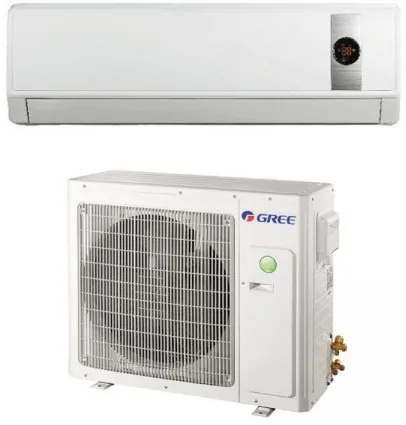
Wall-mounted split systems are suitable for everyday residential cooling.
They work well for:
- Bedrooms.
- Study rooms.
- Small living rooms.
- Small offices.
- Individual commercial rooms.
This is usually the simplest Gree configuration to install and maintain.
### 2. Gree Free Match Multi-Split Systems
Free Match is one of Gree's useful options for multi-room applications.
Instead of installing a completely separate outdoor unit for every room, multiple indoor units can be connected to a compatible outdoor system.
This can be helpful when:
- Several rooms require air conditioning.
- Outdoor space is limited.
- The property owner wants a cleaner exterior.
- Individual indoor units are needed for different rooms.
### 3. Gree Cassette Air Conditioners
Cassette systems are designed for wider airflow distribution and are especially useful for offices, retail spaces, restaurants, and other larger rooms.
They can provide a cleaner installation compared with multiple wall-mounted units when ceiling installation is practical.
### 4. Gree Ducted Air Conditioners
Ducted systems are useful when the goal is to conceal the indoor equipment and distribute air through ceiling outlets.
They are often considered for:
- Offices.
- Larger homes.
- Commercial spaces.
- Renovation projects.
- Spaces where interior appearance is important.
### 5. Gree Standing Air Conditioners
Standing units can be useful where high-volume airflow is needed or wall/ceiling installation is inconvenient.
Gree Singapore lists T-Fresh standing air conditioners within its residential product category.
### 6. Gree VRF Systems
Gree's commercial portfolio includes VRF systems designed for multi-zone buildings.
VRF allows a larger outdoor system to serve multiple indoor units, making it suitable for projects where several spaces require coordinated cooling.
### 7. Gree Chiller Systems
For larger commercial applications, Gree also provides air-cooled chillers, screw chillers, and centrifugal chiller systems.
This is important because it demonstrates that Gree operates across different levels of HVAC requirements rather than focusing only on residential split systems.
Energy Efficiency: Gree Air Conditioners
Gree places significant emphasis on inverter-based operation.
The company's Singapore residential catalogue includes inverter split air-conditioning models with published cooling capacities, COP figures, power input, and energy-related information.
The benefit of inverter technology is straightforward: the compressor can adjust output according to cooling demand.
For example, imagine a bedroom that has already reached the desired temperature.
A fixed-speed compressor may repeatedly turn on and off to maintain the temperature.
An inverter system can instead reduce its operating capacity and maintain the required cooling level more gradually.
This can help improve:
- Energy efficiency.
- Temperature stability.
- Comfort.
- Noise performance.
- Compressor operation.
But buyers should compare the actual efficiency label and technical specification of the specific Gree model.
A brand can have both highly efficient and more basic models.
What Technology Makes Gree Air Conditioners Different?
Gree's technology story is less about flashy consumer electronics and more about compressor control, temperature management, system protection, airflow, and broad HVAC applications.
### G10 Inverter Technology
Gree's product documentation describes G10 Inverter Technology as supporting precise temperature control, lower power consumption, lower noise, and operation under demanding conditions.
This type of inverter control is particularly useful in environments where the air conditioner operates for extended periods.
### Intelligent Temperature Control
Gree systems use temperature sensing and control technologies to adjust operation according to indoor conditions.
The goal is not simply to produce cold air but to maintain the desired room environment without unnecessary compressor operation.
### Corrosion-Resistant Design
Some Gree product lines use corrosion-resistant components for improved durability in demanding environments. Gree documentation describes corrosion-resistant fins intended to improve resistance against salt-spray exposure.
This can be particularly relevant in humid or coastal environments where outdoor units are exposed to moisture and corrosive conditions.
### Wide Operating Voltage
Some Gree systems are designed to operate across a wider voltage range.
This can provide additional protection and stability where electrical conditions are not perfectly consistent.
### Self-Protection Functions
Gree documentation also highlights protective controls that can shut the system down when abnormal conditions are detected.
This is one of those features that may not be exciting at the time of purchase but can be valuable over years of operation.
Core Innovations and Technologies Highlights
| Gree Technology | Main Purpose | Practical Advantage |
|---|---|---|
| Inverter Technology | Adjusts compressor output | Better part-load efficiency |
| G10 Inverter Technology | Fine compressor and temperature control | Efficient and stable cooling |
| Intelligent Temperature Control | Responds to room conditions | More consistent comfort |
| Corrosion-Resistant Fin | Protects heat exchanger surfaces | Better durability in demanding environments |
| Wide Voltage Operation | Supports broader electrical conditions | Improved operational stability |
| Self-Protection | Detects abnormal conditions | Helps protect the system |
Maintenance and Longevity
Gree's technology can only perform as intended when the system is properly maintained.
In Singapore's warm and humid environment, an air conditioner can accumulate dust and moisture relatively quickly.
Regular maintenance should include:
- Filter cleaning.
- Indoor coil cleaning.
- Outdoor condenser cleaning.
- Drain pipe inspection.
- Drainage flushing.
- Refrigerant inspection.
- Electrical connection checks.
- Fan and blower inspection.
- Outdoor unit inspection.
- Temperature-performance testing.
### Why Drainage Matters
One common air-conditioning problem is water leakage from the indoor unit.
The cause may be:
- Blocked drainage.
- Dirty evaporator coil.
- Improper installation.
- Frozen coil.
- Drainage pipe issues.
Routine maintenance helps identify these issues before they become larger problems.
### Why Outdoor Unit Cleaning Matters
The outdoor condenser needs proper airflow to release heat.
If the condenser becomes heavily contaminated with dust and debris, heat transfer can become less effective.
The compressor may then need to work harder, potentially affecting efficiency and system performance.
Compare: Gree vs Other Air Conditioner Brands
Gree is an interesting middle ground for users who want strong air-conditioning engineering without necessarily paying primarily for smart-home ecosystems.
| Factor | Gree | LG | Carrier |
|---|---|---|---|
| HVAC focus | Very strong | Strong | Very strong |
| Residential range | Broad | Broad | Broad |
| Multi-split | Strong | Strong | Available |
| Commercial systems | Very strong | Very strong | Very strong |
| Smart-home focus | Model-dependent | Strong on newer models | Model-dependent |
Gree is particularly attractive when the buyer is focused on the fundamentals: cooling, efficiency, capacity, system flexibility, and durability.
Who Should Choose Gree Air Conditioners?
Gree can be a good choice for:
- Homeowners looking for an air-conditioning-focused manufacturer.
- People wanting inverter technology.
- Multi-room households.
- Users who want several system configurations.
- Offices.
- Restaurants.
- Retail stores.
- Commercial properties.
- Larger HVAC projects.
- Buyers who care more about cooling performance than advanced smartphone features.
It is also worth considering for users who may eventually need a larger HVAC installation because Gree's portfolio extends from residential units to VRF and chiller technologies.
How to Choose the Right Gree Air Conditioner
### 1. Determine the Room Size
Start by calculating the room's approximate cooling requirement.
Avoid buying based only on the idea that "bigger is always better."
An oversized system can have different operating characteristics than a correctly sized system.
### 2. Consider Sun Exposure
A west-facing room with strong afternoon sunlight may require more cooling capacity than a shaded room of the same size.
### 3. Check Occupancy
A bedroom used by one person has a different heat load from a meeting room with ten people.
### 4. Decide Between Single and Multi-Split
For one room, a wall-mounted split system may be enough.
For multiple rooms, Free Match can provide a more coordinated approach where the selected configuration is suitable.
### 5. Consider the Installation Location
Before selecting a model, check where the outdoor unit can be installed.
Important considerations include:
- Ventilation.
- Service access.
- Outdoor exposure.
- Drainage.
- Piping distance.
- Electrical requirements.
### 6. Compare Actual Energy Performance
Do not compare only BTU or cooling capacity.
Look at the model's energy-efficiency information and expected operating cost.
### 7. Think About Maintenance
Ask whether the chosen model can be easily accessed for filter and coil cleaning and whether qualified servicing is available locally.
A Practical Point: Capacity Is Not Everything
One common mistake when buying air conditioning is focusing almost entirely on BTU capacity.
Capacity is important, but it is not the complete story.
Two systems with similar cooling capacity can behave differently because of:
- Compressor technology.
- Heat exchanger design.
- Fan efficiency.
- Installation quality.
- Refrigerant charge.
- Piping length.
- Room insulation.
- Outdoor temperature.
- Maintenance condition.
This is why choosing the correct model and installer is just as important as choosing Gree as the brand.
Pros and Cons Analysis
| Pros | Cons |
|---|---|
| Strong focus on air-conditioning technology | Smart-home features vary by model |
| Broad residential and commercial range | Product selection can feel complex |
| Good variety of inverter systems | Correct sizing is essential |
| Free Match multi-split options | Multi-split installation requires careful planning |
| Cassette and ducted solutions available | Larger systems need professional installation |
| VRF and chiller portfolio | Some advanced systems may be unnecessary for small rooms |
| Corrosion-resistant technologies available on selected models | Actual performance depends heavily on installation and maintenance |
| Strong option for users prioritising core cooling performance | Feature availability differs across markets and models |
Conclusion: Is Gree Air Conditioner a Smart Investment?
Gree is a strong option for buyers who want an air-conditioning-focused brand with a broad range of residential and commercial solutions.
Its biggest advantage is not necessarily one flashy feature. It is the depth of its air-conditioning portfolio.
A homeowner can choose a wall-mounted inverter system, move to a Free Match multi-split configuration for multiple rooms, or consider larger cassette, ducted, VRF, and chiller solutions as the application becomes more demanding.
For buyers who prioritise practical cooling, inverter efficiency, system flexibility, and long-term HVAC capability, Gree deserves serious consideration.
The best investment is still the correctly sized model, professionally installed system, and regular maintenance plan. A good brand can provide the foundation, but proper system selection determines whether that investment performs well in everyday life.