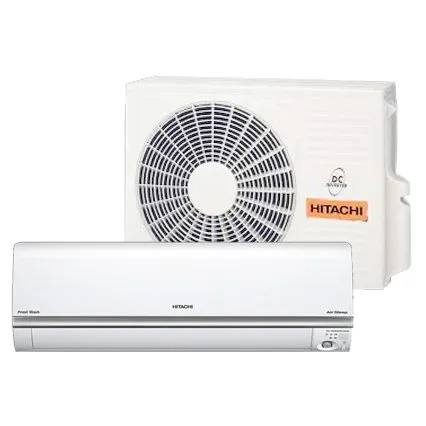
Hitachi Air Conditioners in Singapore: Complete Guide
Hitachi has a long history in engineering and home appliances, and its air-conditioning products reflect a different approach from brands that focus primarily on smart-home connectivity.
Hitachi's current air-conditioning technology places particular attention on heat transfer, compressor control, airflow, air filtration, internal cleaning, and long-term operating performance.
One of the brand's most recognisable technologies in several Asian markets is FrostWash, a cleaning system that freezes the heat exchanger and then melts the accumulated ice to help flush away trapped contaminants.
For Singapore users, this is particularly relevant because an air conditioner operates in a warm and humid environment where moisture, dust, and internal contamination can become ongoing maintenance concerns.
Hitachi therefore has an interesting proposition:
Instead of only making the air conditioner smarter, how can the machine keep its own internal cooling system cleaner and operate more effectively?
That philosophy gives Hitachi a distinctive place in the market.
Why Choose Hitachi Air Conditioners?
Hitachi is worth considering for users who want a combination of:
- Strong cooling performance.
- Inverter control.
- Heat-transfer efficiency.
- Air filtration.
- Internal cleaning technology.
- Controlled airflow.
- Quiet operation.
- Durable components.
Its product technology is particularly interesting for users who care about the condition of the air conditioner's internal heat exchanger.
This is important because the indoor coil is one of the most critical components in an air conditioner.
It is responsible for transferring heat from indoor air to the refrigerant system.
If the coil becomes dirty, airflow and heat transfer can suffer.
Hitachi's approach is to make cleaning and heat-exchanger performance part of the overall product design.
Types of Hitachi Air Conditioning Systems
### 1. Wall-Mounted Inverter Air Conditioners
Wall-mounted inverter systems are suitable for:
- Bedrooms.
- Living rooms.
- Study rooms.
- Home offices.
- Individual commercial spaces.
Hitachi's inverter range includes different cooling capacities for different room sizes.
### 2. Multi-Split Systems
For homes requiring several rooms to be cooled, multi-split configurations can reduce the need for separate outdoor units.
This can provide:
- Cleaner external appearance.
- Better use of outdoor space.
- Independent indoor-room control.
- More organised installation.
### 3. Cassette Systems
Cassette air conditioners are appropriate for larger spaces where ceiling-mounted air distribution is preferable.
They can be suitable for:
- Offices.
- Retail shops.
- Restaurants.
- Meeting rooms.
- Large living spaces.
### 4. Ducted Systems
Ducted air conditioning can be integrated into ceilings and architectural spaces.
This is suitable for homeowners or businesses where visible indoor units are undesirable.
### 5. Commercial and Larger HVAC Applications
Hitachi's wider HVAC capabilities extend beyond small residential split systems.
For larger projects, system design, piping, airflow, capacity, and service support become more important than the basic specification of a single indoor unit.
Energy Efficiency: Hitachi Air Conditioners
Hitachi's energy-efficiency strategy is closely linked to inverter control and precise compressor management.
The concept is similar to other inverter systems, but Hitachi adds its own control technologies.
### Stepless Compressor Control
Selected Hitachi systems use stepless compressor control.
Instead of limiting the compressor to a small number of fixed operating levels, the system can vary compressor speed according to changing indoor and outdoor conditions.
This can help provide smoother cooling.
### Penta Sensor Technology
Selected Hitachi models use Penta Sensor technology to monitor operating conditions.
The system uses sensor information and microcontroller logic to respond to changes in cooling demand.
This is useful in real-world environments because cooling demand is rarely constant.
For example, the room's cooling requirement can change when:
- Several people enter.
- Doors open.
- Sunlight increases.
- Outdoor temperature changes.
- Appliances generate additional heat.
An intelligent control system can respond to these changes rather than operating as if the room were always under identical conditions.
What Technology Makes Hitachi Air Conditioners Different?
### FrostWash
FrostWash is one of Hitachi's most distinctive air-conditioning technologies.
The system freezes the heat exchanger to a very low temperature, causing ice to form and trap dust and contaminants.
The system then melts the ice, allowing the water to flush away the accumulated material.
The objective is to help clean the heat exchanger without requiring the user to manually wash the coil after every period of operation.
This is a useful concept because the heat exchanger is difficult for ordinary users to access.
However, FrostWash should not be treated as a replacement for professional servicing.
It is a maintenance-support technology, not a complete substitute for inspection and cleaning.
### PM2.5 Wasabi Filter
Selected Hitachi systems use a PM2.5 Wasabi Filter designed to capture fine particles while also providing antibacterial, anti-allergen, and deodorising functions.
The filter gives Hitachi a stronger air-care proposition than a basic cooling-only system.
### 100% Inner-Grooved Copper
Selected Hitachi models use inner-grooved copper piping.
The internal grooves encourage turbulent refrigerant flow, improving contact between refrigerant and the pipe wall.
Better refrigerant heat transfer can support faster and more efficient cooling.
Copper also has strong corrosion-resistance characteristics compared with many alternative materials.
### Wave Blade Design
Hitachi uses blade designs intended to improve airflow while reducing noise.
A larger blower combined with specialised blade geometry can help move air further without requiring excessively high fan speed.
### Ambience Light
Selected newer Hitachi models introduce an ambience-light display that visually communicates the current cooling environment.
The light can change depending on the selected temperature range.
This is a relatively small feature, but it gives the indoor unit a more premium user interface.
Core Innovations and Technologies Highlights
| Hitachi Technology | Main Purpose | Practical Benefit |
|---|---|---|
| FrostWash | Freezes and melts the heat exchanger | Helps flush accumulated contaminants |
| Penta Sensor | Monitors operating conditions | More responsive cooling control |
| Stepless Compressor Control | Continuously adjusts compressor speed | Smooth and efficient operation |
| PM2.5 Wasabi Filter | Filters fine particles and supports deodorisation | Additional air-care function |
| Inner-Grooved Copper | Improves refrigerant-side heat transfer | Faster and efficient cooling |
| Wave Blade Design | Improves airflow and reduces air-cutting noise | Quieter and farther-reaching airflow |
FrostWash: Why It Matters in Singapore
Singapore's climate makes internal air-conditioner cleanliness particularly important.
The indoor heat exchanger regularly becomes wet during cooling.
Over time, the combination of:
- Moisture.
- Dust.
- Airborne particles.
- Organic material.
can create an environment where dirt and contamination accumulate.
A conventional air conditioner requires regular professional cleaning to address this.
FrostWash provides an additional maintenance-support mechanism.
The freeze-and-melt cycle can help dislodge and flush contaminants from the heat exchanger.
This is particularly valuable because the heat exchanger is not an easy component for homeowners to manually clean.
### But There Is an Important Limitation
Self-cleaning technology does not mean "no servicing required."
A professional technician still needs to inspect:
- Drainage.
- Blower.
- Fan.
- Electrical components.
- Refrigerant system.
- Outdoor condenser.
- Heat exchanger condition.
- General operating performance.
FrostWash should therefore be viewed as one layer of maintenance support, not a replacement for professional care.
Maintenance and Longevity
Hitachi's maintenance strategy benefits from technologies such as FrostWash and specialised filters, but the normal maintenance rules still apply.
### Filter Cleaning
Even if the system has a specialised filter, the filter should be inspected and cleaned according to the manufacturer's instructions.
A blocked filter restricts airflow.
### Heat Exchanger Care
The heat exchanger needs to remain reasonably clean for efficient heat transfer.
FrostWash can assist with this on supported models.
### Drainage Inspection
Water produced during cooling must leave the indoor unit properly.
A blocked drainage system can cause:
- Water leakage.
- Bad odours.
- Reduced performance.
- Internal moisture problems.
### Outdoor Unit Maintenance
The outdoor condenser is equally important.
It releases the heat removed from the room.
If the outdoor coil becomes heavily contaminated, heat rejection can become less effective.
### Professional Servicing
Even a self-cleaning air conditioner should be professionally inspected periodically.
This is particularly important for households operating the air conditioner every day.
Compare: Hitachi vs Other Air Conditioner Brands
| Factor | Hitachi | Fujitsu | LG | EuropAce |
|---|---|---|---|---|
| Inverter technology | Strong | Strong | Strong | Available |
| Internal cleaning technology | Strong on selected models | Strong on selected models | Strong on selected models | Model-dependent |
| FrostWash | Distinctive Hitachi feature | Not the same technology | Different cleaning approaches | Different approaches |
| Air filtration | Strong on selected models | Strong on selected models |
Hitachi is particularly attractive when internal cleanliness and heat-exchanger maintenance are high on the buyer's priority list.
Who Should Choose Hitachi Air Conditioners?
Hitachi is a good choice for:
- Homeowners who use AC frequently.
- Families concerned about indoor air quality.
- Bedroom users.
- Users who appreciate self-cleaning technology.
- People who want inverter efficiency.
- Buyers interested in advanced sensor control.
- Users who prefer engineering-focused products.
- Homes where long-term maintenance convenience matters.
It can also be a strong option for users who do not want to spend too much time thinking about cleaning the internal heat exchanger but still understand that professional servicing is necessary.
How to Choose the Right Hitachi Air Conditioner
### Step 1: Calculate Cooling Requirement
Start with room size.
Then consider:
- Sunlight.
- Windows.
- Ceiling height.
- Occupancy.
- Appliances.
- Insulation.
### Step 2: Decide How Important Self-Cleaning Is
If internal cleanliness is a major priority, compare Hitachi models that include FrostWash.
### Step 3: Check the Filter
If air filtration matters to you, look at the exact filter technology included in the model.
Do not assume every Hitachi model has identical air-treatment features.
### Step 4: Consider Noise
For bedrooms, examine indoor sound levels and airflow behaviour.
A quiet machine can be more valuable than a long list of features.
### Step 5: Compare Energy Performance
Look at the actual efficiency specifications for the model rather than relying only on the Hitachi brand.
### Step 6: Choose the Correct Capacity
Do not intentionally oversize an air conditioner just because you want faster cooling.
Correct sizing provides a better balance between cooling performance, comfort, and energy use.
### Step 7: Check Installation Requirements
Before purchasing, confirm:
- Indoor-unit location.
- Outdoor-unit location.
- Piping distance.
- Drainage.
- Electrical requirements.
- Maintenance access.
A Different Point: Self-Cleaning Is About More Than Convenience
It is easy to look at FrostWash and think of it as a convenience feature.
But there is a deeper reason why the technology matters.
The indoor heat exchanger directly affects cooling performance.
When it becomes contaminated, heat transfer can become less effective.
That means the compressor may have to work harder to achieve the same result.
Therefore, keeping the heat exchanger cleaner is not only about smell or appearance.
It can also support the basic job of the air conditioner:
moving heat efficiently.
This makes Hitachi's cleaning technology more relevant to long-term performance than it may initially appear.
Pros and Cons Analysis
| Pros | Cons |
|---|---|
| Strong inverter technology | Advanced models can cost more |
| FrostWash is a distinctive cleaning feature | FrostWash does not eliminate professional servicing |
| Strong heat-exchanger engineering | Technology varies between models |
| Penta Sensor technology on selected models | Sensor features may be unnecessary for simple rooms |
| PM2.5 filtration on selected models | Replacement/cleaning requirements still apply |
| Good airflow and noise-control engineering | Correct sizing remains essential |
| Inner-grooved copper technology | Installation quality affects final performance |
| Strong option for frequent AC users | Premium features can increase purchase price |
Hitachi for Bedrooms: A Particularly Good Match?
Bedrooms are one of the areas where Hitachi's combination of technologies can make sense.
A bedroom air conditioner should ideally provide:
- Quiet operation.
- Stable temperature.
- Gentle airflow.
- Clean internal components.
- Convenient maintenance.
- Low unnecessary energy consumption.
Hitachi's inverter control helps maintain cooling demand more smoothly.
Its airflow technology can help distribute air without excessive noise.
Its self-cleaning technology can support internal heat-exchanger cleanliness.
And sleep-related features on selected models can make nighttime operation more comfortable.
This does not mean Hitachi is automatically the best bedroom air conditioner for everyone. But its feature set is well aligned with the requirements of a room that operates for several hours every night.
Conclusion: Is Hitachi Air Conditioner a Smart Investment?
Hitachi is a smart investment for buyers who value engineering precision, cooling performance, internal cleanliness, and long-term comfort.
Its strongest differentiator is the way technologies such as FrostWash, Penta Sensor, stepless compressor control, specialised filtration, and inner-grooved copper work around the core air-conditioning system rather than simply adding decorative features.
For a household that uses air conditioning frequently, these details can become more important over time.
Hitachi is not necessarily the cheapest choice, and not every user needs every advanced feature.
But if your priorities are clean internal components, stable cooling, efficient compressor control, good airflow, and reduced maintenance burden, Hitachi deserves serious consideration.
The best Hitachi system is still the one that matches the room correctly. Choose the right cooling capacity, verify the energy performance of the exact model, ensure professional installation, and maintain the system regularly.
In that situation, Hitachi's engineering-focused approach can turn an air conditioner from a simple cooling appliance into a more considered long-term investment.